


Recently I stumbled on the following picture. My instant thought was:
Wow, butterflies remember us from their caterpillar stage — what a heartwarming story. Like we matter to tiny insects. Just treat them well, and they come back to you as beautiful butterflies.
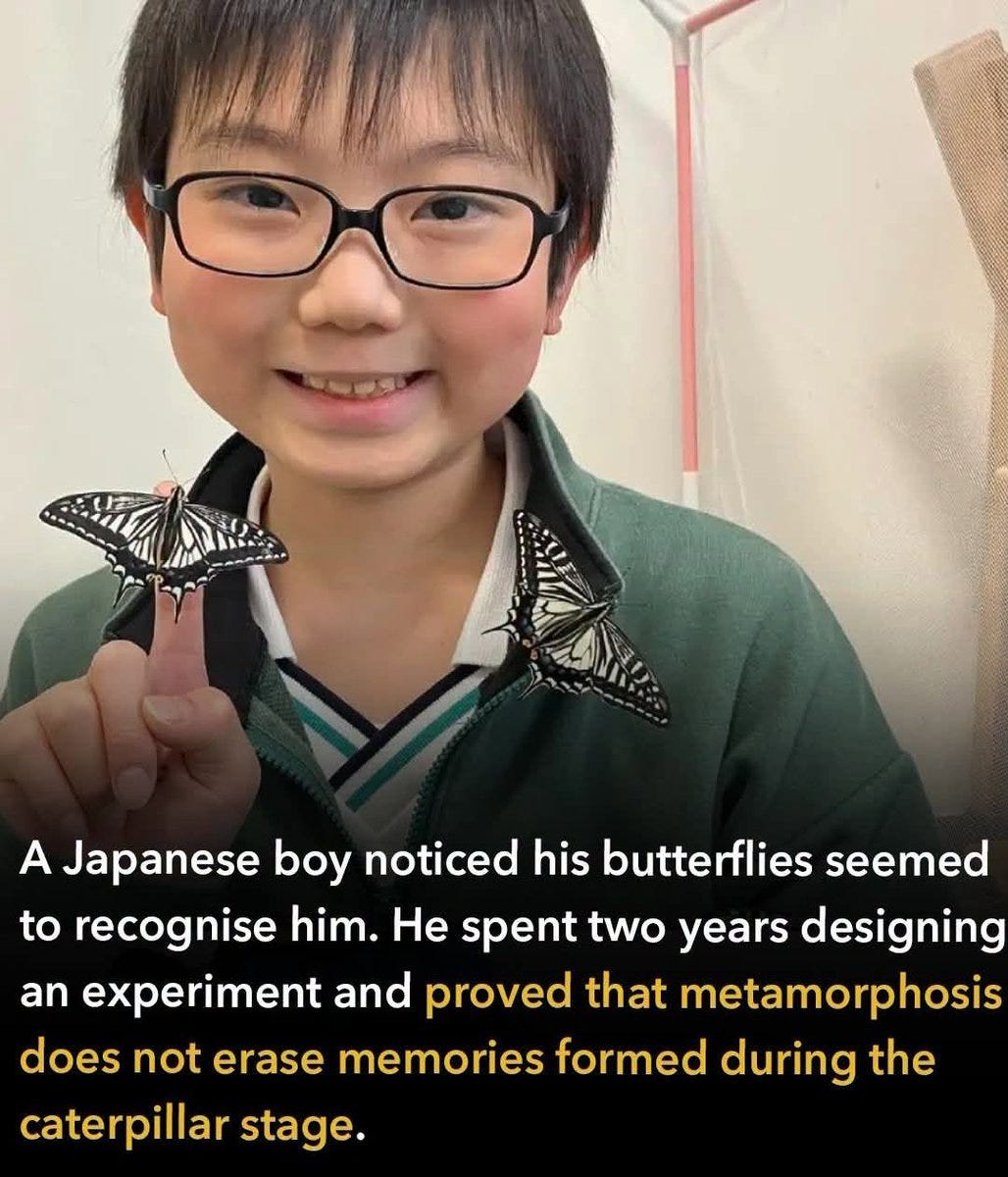
And then I noticed that I read the text with my heart and not with my mind.
It didn’t say that the butterflies remember him. And later on in my research, I also found out that the memory thingy is not exactly true.
My story could have ended here like it’s often the case with many of these clickbaity things. But there was actually something valuable in what the Japanese boy discovered.
What did actually happen?
The 10-year-old Jo Nagai raised swallowtail butterflies at his home in Kobe, Japan. He noticed that the butterflies he cared deeply about when they were caterpillars didn’t fly right away when he released them. They stayed with him for a bit until they eventually moved on.
He then set up an experiment to test whether the memory of caterpillars stays intact even after metamorphosis. For this, he released some lavender scent right before giving them a mild vibrational stimulation. Well, actually it wasn’t that mild, as the caterpillar had to vomit from that. But hey, they survived it.
Later, when they were butterflies, he released lavender scent again, and the insects directly avoided it. He tried the same with the 2nd generation of those initially stimulated insects. The young ones also avoided the lavender scent without ever being stimulated.
What does this show?
Somehow the tendency to avoid lavender was passed to the next generation. The experiment does not show whether actual memories were passed.
Still, it’s incredible to see how learned responses are passed from one to next generation.
There are similar experiments with mice which showed the same.
I don’t know about us humans. Maybe we have that too. And if that’s the case, maybe we still avoid things that are no longer harmful to us.
For me, that’s something to ponder.
Something to ponder indeed... 🤔🤔🤔